Metal rust is a common challenge for cars, trailers, tools, and outdoor equipment. The right rust converter can turn active rust into a stable, paint-ready coating, helping prevent further corrosion without extensive sanding. Below you’ll find five leading rust converter picks, each offering different advantages for DIYers and professionals. This guide also explains what to look for when choosing a rust converter and how these products compare on key points like application method, coverage, and safety.
| Product | Brand | Best For |
|---|---|---|
| Seymour 16-45 Rust Converter | Seymour | Vehicles, trailers, fences |
| Corroseal 82320 Water-Based Rust Converter | Corroseal | One-step rust conversion and priming |
| DWIL Rust Converter for Metal | DWIL | Auto, tools, outdoor metal |
| Corroseal Rust Converter & Metal Primer | Corroseal | Industrial and large-area rust control |
| Meuvcol 2-in-1 Rust Converter & Metal Primer | Meuvcol | High-volume projects and durability |
Seymour 16-45 Rust Converter, Black

The Seymour 16-45 Rust Converter is designed to penetrate loose rust and convert it into a protective black coating. It aims to halt rust growth and prepare the surface for painting, making it suitable for vehicles, trailers, fences, railings, sheet metal, and storage tanks. The product emphasizes deep rust penetration and long-term corrosion resistance, helping prevent future rust formation once dry.
Corroseal-82320 Water-Based Rust Converter Metal Primer

Corroseal 82320 combines rust conversion with priming in a single step. It transforms rusted metal into a durable, paint-ready finish without grinding or sanding. The formula creates a robust anti-rust seal that blocks moisture, salt, and oxidation from returning, and it can be brushed, rolled, or sprayed on. It dries to a solid black coat and is noted for being low odor and easy clean-up, covering roughly 60-63 square feet per quart.
DWIL Rust Converter for Metal, 2 in 1 Rust Converter Paint and Primer
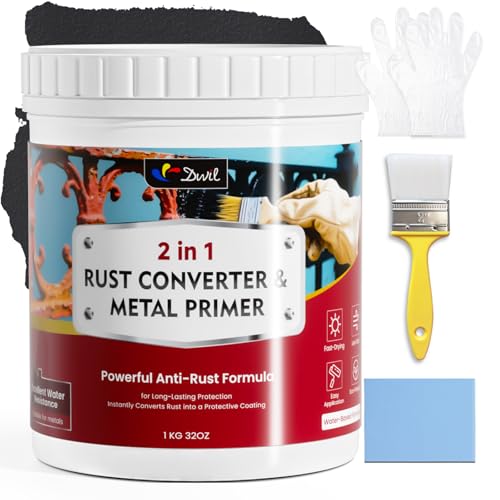
DWIL’s offering acts as both a rust converter and a primer, turning rust into a stable black coating and eliminating the need for separate primer. It is presented as suitable for cars, tools, fences, gates, machinery, and marine equipment. By combining conversion and priming in one step, it aims to simplify prep work and accelerate project timelines while forming a durable barrier against future corrosion.
Corroseal Rust Converter & Metal Primer

This Corroseal option combines rust conversion with metal priming in a gallon-size container. It provides a strong rust-inhibiting layer intended to stop rust and prevent future corrosion. The product is described as low odor and non-flammable, suitable for cars, trucks, trailers, marine equipment, and industrial applications, with broad coverage roughly 200–250 square feet per gallon depending on surface porosity.
Meuvcol 2-in-1 Rust Converter & Metal Primer
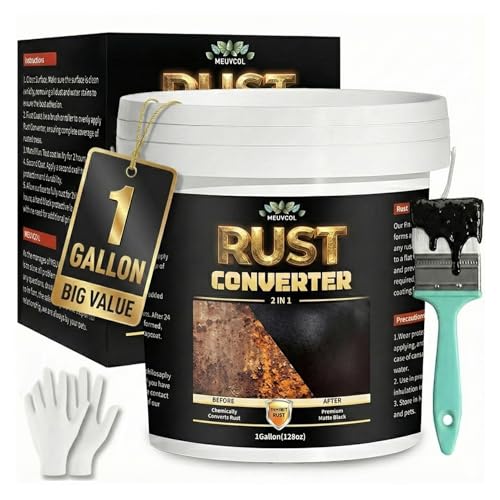
Meuvcol’s 2-in-1 rust converter and primer is offered in a gallon bottle and also a 35-ounce variant. It emphasizes high performance with a single-component, ready-to-use formula that seals out water and air. It is positioned for automotive, truck, farm, industrial, marine, and construction use, making it suitable for large-scale projects or frequent rust-prone environments. The product touts durable anti-rust coverage and long-lasting protection against oxidation.
Buying Guide: Key Considerations When Choosing A Rust Converter
When selecting a rust converter, buyers should weigh how the product will be used, the severity of rust, and whether they prefer a single-step solution or a dedicated primer. Important factors include the base formulation (water-based vs solvent-based), curing time, and surface readiness for painting. Water-based formulas tend to emit fewer odors and be easier to clean up, while solvent-based variants may offer deeper rust penetration in challenging conditions. Consider coverage per gallon to estimate project scope and determine if a primer is included or required for topcoat adhesion.
Application method matters: some products are designed for brushing, rolling, or spraying, while others are optimized for more automatic or spray-friendly scenarios. Surface prep remains a factor; while some rust converters claim “no sanding required” in many cases, removing loose debris and cleaning the surface can improve adhesion and final finish. The presence of a clear or milky white to black transition can help indicate proper curing. Finally, evaluate safety considerations such as low odor, non-flammability, and ease of cleanup, especially for indoor work or enclosed spaces.
Performance And Longevity: How To Choose For Your Situation
For DIY projects involving fences, trailers, or outdoor tools, a single-step rust converter with good primer compatibility can save time without sacrificing protection. For larger metal surfaces or equipment exposed to saltwater or heavy moisture, a gallon-size primer-and-converter combo can provide extended corrosion resistance and easier top-coating. If you anticipate frequent exposure to harsh conditions or need broad coverage, consider products marketed for industrial or marine use and check the stated square footage per gallon. Always follow manufacturer instructions for drying times before applying topcoat.
Safety, Storage, And Maintenance
Read safety data sheets and product labels to understand ventilation needs, skin contact precautions, and proper storage. Many rust converters are low-odor and non-flammable, but some may require disposal as a special waste. Store containers in a cool, dry place away from heat sources. After application, inspect the coated surface periodically for signs of rust bleed-through or coating degradation, and reapply as needed to maintain protection. For long-term durability, pairing a rust converter with a compatible topcoat can maximize life expectancy.