Epoxy resin projects demand pristine clarity, smooth surfaces, and bubble-free finishes. A dedicated vacuum chamber with a pump accelerates degassing, reduces curing flaws, and speeds up production. This article examines practical options for resin, silicone, and epoxy degassing, comparing chamber sizes, pump power, and lid visibility. Below are five selected products commonly used in American studios and workshops, followed by a buying guide to help you choose the right setup for your needs.
| Product | Chamber Size | Pump (CFM) | Special Feature |
|---|---|---|---|
| VEVOR 3 Gallon Vacuum Chamber | 3 Gallon | 3.5 | Acrylic lid for monitoring |
| VEVOR 5 Gallon Vacuum Chamber | 5 Gallon | 3.5 | Stable, large capacity |
| Resiners Resin Bubble Remover Airless Pro | 3.2 L capacity | Not specified | Fast degassing with smart touchscreen |
| VTG VOGTEN 5 Gallon Chamber | 5 Gallon | 4.5 | Includes full tool kit |
| BACOENG 3 Gallon Tempered Glass Lid | 3 Gallon | 3.6 | Tempered glass lid for visibility |
VEVOR 3 Gallon Vacuum Chamber and Pump Kit

The VEVOR 3 Gallon Vacuum Chamber kit combines a stainless steel chamber with a 3.5 CFM single-stage pump, designed for resin debubbling and resin degassing. It features an acrylic lid that stays transparent during degassing, enabling real-time monitoring of bubble escape. The four-stage copper motor provides steady operation, while a built-in cooling fan helps prevent overheating during extended sessions. This kit is well-suited for smaller resin projects, jewelry casting, and silicone work where air removal is critical. Note that it is not recommended for wood stabilization work.
VEVOR 5 Gallon Vacuum Chamber and 3.5 CFM Pump Kit

This larger VEVOR kit matches the 5-gallon chamber with a robust 3.5 CFM pump for efficient degassing. The stainless steel chamber resists warping under pressure, and the acrylic lid allows you to visibly track degassing progress. Ideal for bigger resin batches, silicone casting, and epoxy projects where higher resin volumes demand quick, uniform air removal. As with the 3-gallon version, this set notes suitability for resin and silicone work rather than wood stabilization.
Resin Bubble Remover by YixangDD

The Resin Bubble Remover from YixangDD offers a compact, digitally controlled solution for rapid bubble elimination. With a 2.7-liter capacity and a portable footprint, it suits small to mid-size projects needing quick degassing. A touchscreen-style display shows pressure and time, with modes for 5 and 10 minutes. The unit is designed to minimize resin splashing and operate quietly, making it a practical choice for home studios or craft workshops seeking fast results without heavy equipment.
Resiners Resin Bubble Remover Airless Pro

The Airless Pro from Resiners targets industrial bubble removal with 99.99% efficiency. Featuring a large 3.2L capacity, it can process up to 27.05 ounces per cycle, making it suitable for both jewelry components and larger resin artworks. Its patent-pending design includes a user-friendly touchscreen with multiple time settings (5/10/15 minutes) and real-time vacuum monitoring. This model emphasizes speed, high capacity, and precise control of the degassing process.
BACOENG 3 Gallon Tempered Glass Lid Vacuum Chamber
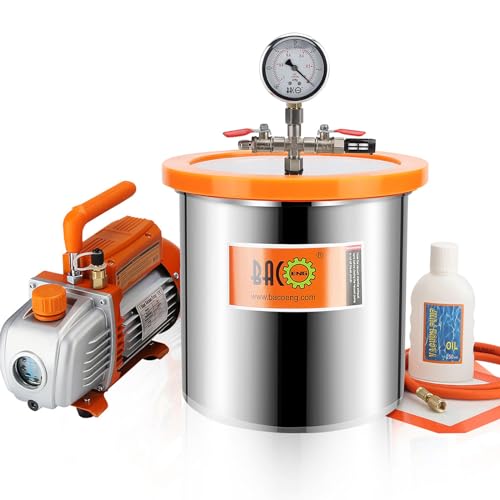
The BACOENG 3 Gallon system pairs a robust 3.6 CFM pump with a stainless steel chamber and a tempered glass lid. The glass lid offers high light transmission and visibility, letting users observe defoaming without opening the chamber. A 5-foot reinforced hose and copper motor deliver reliable performance, while the 3.6 CFM rating provides steady airflow for smaller resin batches. This setup emphasizes visibility, efficiency, and durability for hobbyists and professionals alike.
Buying Guide
Choosing the right vacuum chamber for epoxy resin involves balancing capacity, pump power, and practical usability. Key considerations include:
- Chamber size: Smaller volumes heat up and degas quickly, but limit batch size. Larger chambers allow bigger projects but require more powerful pumps and more careful handling.
- Pump specification: Look for CFM ratings around 3.5–4.5 for standard resin work. Consider ultimate vacuum levels (Pa or inHg) to assess degassing efficiency.
- Chamber material: Stainless steel resists deformation and chemical exposure; tempered glass lids provide visibility and durability. Acrylic lids offer cost savings with clear observation windows.
- Lid design and visibility: A clear lid or full transparent view helps monitor bubble evolution without opening the chamber and reintroducing air.
- Noise and heat management: Copper-motor pumps with cooling fans reduce heat buildup and maintain stable performance during longer sessions.
- Compatibility: Some kits note suitability only for resin and silicone, not wood stabilization. Confirm your intended materials before purchasing.
- Accessories: Hose length, extra filters, and installation tools affect setup convenience and future maintenance.
For professional or heavy-use environments, a larger chamber with a high-flow pump offers efficiency gains, especially when processing multiple resin pours or larger pieces. For hobbyists or small studios, compact 3-gallon units with transparent lids provide a cost-effective entry point while still delivering reliable degassing performance. When comparing models, consider whether you value quick cycles, capacity, or visibility most—and how that aligns with your typical project size and workflow.
All products listed are commonly used in epoxy resin, silicone, and UV resin crafting. They provide a spectrum of options from compact, fast-degas to larger capacity setups, enabling users to choose based on batch size, project type, and workspace constraints. Remember to follow safety guidelines and manufacturer instructions for best results and longer equipment life.