When you want lighting to come on and go off automatically without manual touch, a reliable indoor timer is essential. This guide reviews five top options, highlighting ease of use, flexibility, and power-saving features. Ideal for lamps, fans, holiday lights, and small appliances, these timers offer varied settings—from simple 24-hour cycles to multi-day programmable schedules—so you can choose the best match for your home or office.
Summary of chosen products:
| Product | Brand | Type | Key Benefit |
|---|---|---|---|
| BN-LINK BND-60/U47 Indoor Mini 24-Hour Mechanical Outlet Timer, 3-Prong, 2-Pack | BN-LINK | Mechanical, 2-pack | Simple push-pin on/off, 24 settings per day |
| GE Mechanical Grounded Outlet Timer, Dual Plugs, 24-Hour Cycle, Indoor | GE | Mechanical, dual-outlet | Two timed outlets, daily cycle |
| BN-LINK Indoor Digital Timer Outlet, Dual Outlet 7 Day Programmable | BN-LINK | Digital, 2 outlets | Up to 8 on/off programs per outlet, Daylight Savings |
| BN-LINK Indoor Timers Plug Mechanical 2 Prong 24-Hour Mini | BN-LINK | Mechanical, 2-prong | 24-hour cycle, compact design |
| GE Mechanical Grounded Outlet Timer, Dual Plugs, 24-Hour Cycle, Indoor | GE | Mechanical, dual-outlet | Daily control for two devices |
BN-LINK BND-60/U47 Indoor Mini 24-Hour Mechanical Timer

The BND-60/U47 is a compact, two-pack mechanical timer with 3-prong outlets. Its pins indicate state: pins DOWN mean ON, pins UP mean OFF. The countdown settings are designed for quick daily repeats with up to 24 on/off intervals per day. This makes it suitable for lamps, small appliances, and seasonal displays. Each unit is simple to program: pull pins to set on/off times, then plug in and let the daily schedule repeat. Two timers per pack provide flexibility for separate devices or rooms.
GE Mechanical Grounded Dual-Outlet Timer, 24-Hour Cycle

This GE timer provides a straightforward mechanical solution with dual outlets, each controlled by a shared 24-hour cycle. The pushpin design ensures quick setup and reliable daily operation for lights, fans, or decor accents. The dual outlet feature allows two three-prong devices to be automated simultaneously, simplifying installation for two lamps or a small fan. It’s a budget-friendly option for basic, dependable timers without the complexity of digital programming.
BN-LINK Indoor Digital Timer Outlet, Dual Outlet 7 Day Programmable
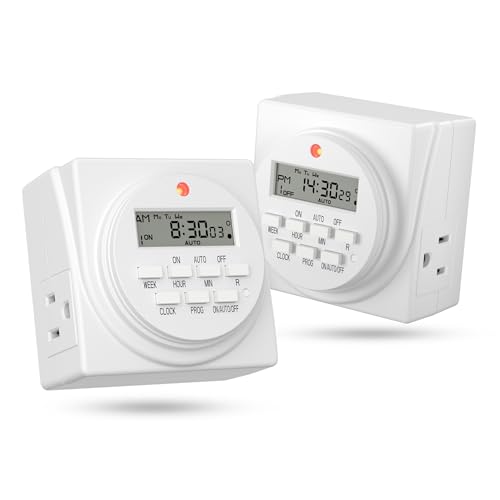
This digital timer from BN-LINK expands scheduling beyond a single day, offering seven-day programmability with two controlled outlets. It supports up to eight on/off programs and short minute-level increments for precise control. Features like Daylight Savings mode and a backup battery help preserve settings during outages. A noticeable benefit is the random Vacation mode, which can simulate occupancy by randomizing lighting, adding a layer of home security while you’re away.
BN-LINK Indoor Timers Plug Mechanical 2 Prong 24-Hour Mini

This two-pack provides a compact 24-hour mechanical timer in a two-prong design. Pins UP/OFF and DOWN/ON operation mirrors other mechanical BN-LINK timers, making it easy to translate familiarity across devices. It’s well-suited for outlets powering lamps, fish tanks, or small appliances where a simple, no-frills schedule suffices. The 24-hour cycle repeats daily for convenient, hands-off control without the need for batteries or digital settings.
BN-LINK Indoor Digital Timer Outlet, 7 Day Programmable (One Pack)

This BN-LINK model offers a compact digital solution with two grounded outlets and up to eight on/off programs per outlet. It supports Daylight Savings mode and has a reliable backup battery to retain settings during outages. Like other BN-LINK timers, it emphasizes ease of use with a simple button layout and quick setup, making it a practical choice for homes with varied lighting needs or multi-room automation.
GE Mechanical Grounded Dual Outlet Timer, 3-Pack

This GE 3-pack provides a reliable mechanical control option across multiple outlets in one purchase. The dual-outlet design enables synchronized timing across two devices, useful for lamps or small fans placed in different rooms. The mechanical operation and 24-hour cycle deliver straightforward daily automation, making it a cost-effective solution for users who prefer a simple, durable timer without digital features.
Buying Guide: Key Purchase Considerations
- Type and complexity: Mechanical timers are simple, durable, and battery-free but offer fewer scheduling options. Digital timers provide multi-day programming, more precise timing, and features like backup batteries and daylight saving adjustments. Choose based on your need for simplicity or advanced scheduling.
- Outlets and compatibility: Count how many devices you want to automate and whether you need single or dual outlets. Ensure the timer’s plug type fits your outlets (three-prong vs two-prong) and that it supports the devices you plan to automate.
- Program frequency: If you want daily repeats, a 24-hour timer may suffice. For varied weekly routines, a 7-day digital timer offers more flexibility and granularity.
- Power resilience: Look for models with backup batteries or non-volatile memory to preserve settings during outages. This helps ensure your schedules remain consistent after a power interruption.
- Security and energy savings: Timers can reduce standby power and improve energy efficiency. Some models include a “Random” Vacation mode to simulate occupancy, which can deter break-ins in your absence.
- Ease of use and installation: Mechanical timers are often the fastest to set up, while digital timers may require navigating menus. Consider your comfort with technology and the need for quick, repeatable routines.
- Size and placement: Compact designs save outlet space and reduce clutter. If you’re tight on space, a timer with a slim footprint or an integrated outlet design can help.
- Quality and safety: Ensure timers are ETL-listed or UL-listed for safety and reliability. This is especially important when used with heating or high-wattage appliances.
In summary, the best timer for indoor lights depends on your priorities: simplicity and reliability (mechanical timers) or flexible programming and advanced features (digital timers). The options reviewed here cover a spectrum—from straightforward, budget-friendly mechanical timers to feature-rich digital models—so you can automate your lighting with confidence and efficiency.