Choosing the right tile membrane can dramatically reduce cracks and damage as substrates move with temperature and moisture changes. This article highlights five top-rated underlayments designed to decouple tile from substrate movement, provide waterproofing, and improve installation longevity. Each option below is suitable for common flooring projects—from bathrooms to kitchens and basements—helping you select a membrane that matches your substrate and climate while keeping installation straightforward.
Summary of Selected Products
| Product | Brand | Size / Coverage | Key Benefit |
|---|---|---|---|
| Schluter Ditra Uncoupling Membrane | Schluter | 1/8″ Thick, 54 sq ft | Effective crack prevention with moisture barrier |
| Schluter Kerdi Bonded Membrane | Schluter | 3’3″ width, 33′ length, 108 sq ft | Waterproofing and vapor retardation with strong adhesion |
| Houseables Uncoupling Membrane (323 Sq Ft) | Houseables | 1/8″ Thick, 3.3 ft x 98.5 ft | Crack prevention with easy installation |
| Drydiet Uncoupling Membrane (108 Sq Ft) | Drydiet | 1/8″ Thick | Protection against substrate movement and moisture |
| MAXWAVE 17″ x 150′ Underlayment | MAXWAVE | 20 mils thick, 212.5 sq ft | High density PE with moisture control and vapor retardation |
Schluter Ditra Uncoupling and Waterproofing Membrane

Schluter Ditra provides an uncoupling layer that neutralizes stress between substrate and tile, helping prevent cracking and delamination in ceramic and stone installations. It supports multi-surface compatibility with concrete, plywood, OSB, and gypsum, and integrates as a moisture barrier suitable for heated floors. Installation is designed to be straightforward with thin-set mortar, allowing consistent tile adhesion while maintaining a reliable substrate separation.
Schluter Kerdi Bonded Membrane for Tile

Kerdi Bonded Membrane is a waterproofing and vapor-retardant layer designed for tile installations. With a PEVA core and non-woven polypropylene on both sides, it offers robust moisture protection while maintaining dimensional stability. The membrane features an anchoring fleece on both sides to ensure strong adhesion with thin-set mortar, supporting reliable tile installations across bathrooms, kitchens, and other moisture-prone areas.
Houseables Uncoupling Membrane (Large Roll)
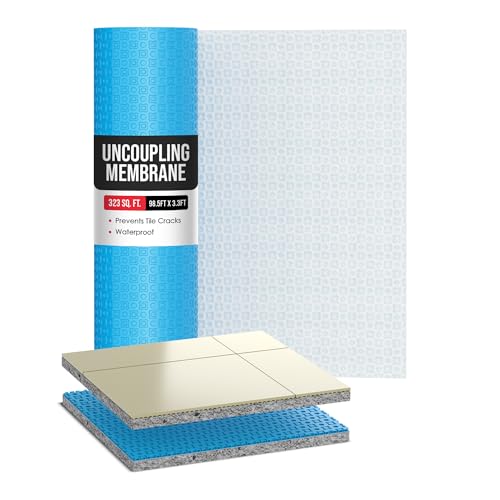
This 323 sq ft underlayment helps decouple tile from substrate movement, preventing cracks and ensuring a smooth tile surface. It’s installed by laying thin-set on the substrate, applying the membrane, and continuing with tile installation directly over the membrane. The low additional thickness preserves floor height while providing essential crack prevention, vapor management, and anti-fracture benefits.
Drydiet Uncoupling Membrane (108 Sq Ft)

Drydiet’s 108 sq ft uncoupling membrane is designed to absorb substrate movements, mitigating stress transmissions to tiles. It provides a protective barrier between tiles and substrate, suitable for kitchens, basements, bathrooms, and showers. The product emphasizes easy DIY installation while offering durable crack prevention and moisture resistance for vulnerable substrates like plaster, drywall, or wood.
MAXWAVE 17″ x 150′ Underlayment

MAXWAVE offers a wide, single-roll membrane measuring 17 inches by 150 feet, with a thickness of 20 mils. The product features high-density polyethylene for superior waterproofing and a vapor-retardant layer that helps prevent dampness in steam rooms or high-humidity spaces. Its reinforced construction with non-woven polypropylene on both sides and filament fiber exterior enhances durability and ease of handling.
Buying Guide
Key considerations when selecting a tile underlayment membrane:
- Crack prevention vs. moisture protection: Some membranes focus primarily on decoupling to reduce cracks, while others pair decoupling with an integrated moisture barrier. Consider your substrate type and climate when choosing.
- Substrate compatibility: Ensure the membrane is compatible with common substrates such as concrete, plywood, OSB, plaster, and drywall. Heated floors may require specific membranes designed for thermal expansion.
- Thickness and installation: Membrane thickness can affect floor height and ease of installation. 1/8″ (3 mm) options are common, but verify compatibility with your tile system and layout.
- Coverage and waste: Large rolls reduce seams but may require more cutting. Calculate coverage to avoid shortages or excessive waste; consider layout and room dimensions.
- Adhesion and preparation: Some membranes rely on thin-set mortar for adhesion, while others include pre-attached layers. Follow manufacturer guidance to ensure proper adhesion and performance.
- Moisture and vapor control: For bathrooms, basements, or kitchens, prioritize membranes with vapor retardation and moisture barriers to protect substrate integrity over time.
- Installation environment: In multi-room projects, a uniform membrane system can simplify installation and ensure consistent performance across areas exposed to different moisture levels.
When evaluating options, compare certifications, warranty terms, and installation instructions. For most residential bathrooms and kitchens, Schluter Ditra and Schluter Kerdi offer well-established performance in both crack prevention and waterproofing. Larger-area jobs may benefit from Houseables or Drydiet membranes for cost-effective decoupling with adequate performance. The MAXWAVE option provides a robust moisture barrier with a long, roll-based footprint suitable for expansive showers or spa-like spaces.