Home flood protection is essential in flood-prone areas. Modern, reusable barriers offer quicker deployment, less mess, and stronger seals than traditional sandbags. This guide reviews five durable, permanent flood barrier options that homeowners can rely on to defend doorways, garages, basements, and other entry points. Each option varies in installation, materials, and adaptability, so readers can compare performance, reuseability, and setup requirements at a glance.
Summary of chosen products
- Dam Easy – Door Dam Flood Barrier (Doorways, up to 28 inches)
- Flood Hero – 3 ft Water Activated Sandbags (2 Pack)
- Quick Dam – QD65-2 5′ Barrier (2 Pack)
- Flood Protection Barrier – L-Shaped Aluminum System (10-pcs)
- Minventiss – 4 Pack 6 ft Flood Barrier
Dam Easy Door Flood Barrier Review

The Dam Easy system is designed for quick placement without adhesives, hardware, or damaging additions to a home. It extends to fit door openings and inflates to form a watertight seal, providing protection against floodwater. Installation is noted as possible in under five minutes, making it a practical option for rapid response during impending storms. This barrier emphasizes a clean, door-friendly method that reduces the mess associated with traditional sandbags while delivering a strong, defendable seal at entry points.
Key features include a simple, tool-free deployment and a portable profile that minimizes obstruction when doors are opened. The system relies on an inflatable seal to block water ingress, which can be advantageous for homeowners seeking a fast, low-effort safeguard before a flood event. The design focuses on residential doorway protection and aims to be a reliable barrier that can be installed with minimal notice.
Considerations for Dam Easy include ensuring the opening measurements align with the product range and confirming that the door frame provides a suitable seal area for inflation. While not a full perimeter solution, this barrier offers targeted protection where water intrusion is most likely at entry points, with the added benefit of rapid setup and removal after flood risk passes.
Flood Hero 3 ft Water Activated Sandbags
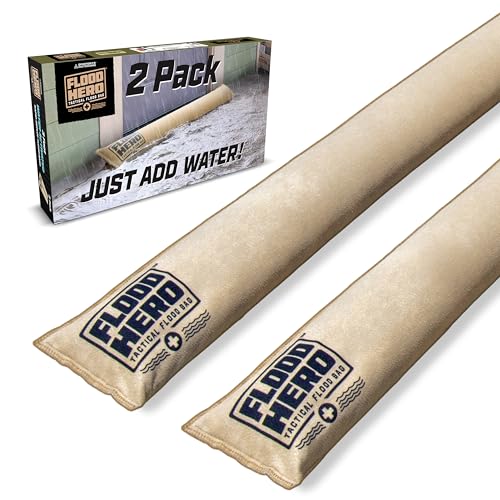
Flood Hero flood barriers use water-activated materials to create a sandbag-like barrier without actual sand. This 2-pack is designed for doorways and other at-risk entry points, deploying in about 5–10 minutes. The product uses a Water Gel technology to maintain its shape and stay in place, reducing the need for shovels, sand, or heavy lifting. It is lightweight and foldable for compact storage when not in use, making it a practical option for homeowners who want quick deployment and reusable performance.
Key advantages include easy handling, no sand required, and the ability to fill and activate at the site with minimal effort. The 36″ length per barrier offers a reasonable reach for typical doorways, with an expanded height to better accommodate varying entry designs. The 2-pack configuration supports broader coverage by pairing multiple units as needed for larger openings or multiple entry points.
Considerations for Flood Hero include ensuring appropriate sizing for doorways and evaluating storage space for multiple units. While convenient for rapid responses, homeowners should assess how many units are needed to cover all vulnerable points in a residence and plan for storage during off-season periods.
Quick Dam QD65-2 5′ Barrier (2 Pack)

The Quick Dam QD65-2 barrier system offers a water-activated flood solution designed to easily reach 3.5 inches in height within minutes. The long, flexible design allows homeowners to shape and form barriers around doors, thresholds, and irregular entry points, providing adaptable coverage for complex layouts. The product is marketed as highly responsive, requiring only wetting to activate sealing capacity, which can expedite readiness when flood risk is imminent.
Strengths of this system include its flexibility, ease of deployment, and the ability to create custom configurations for doorways and other openings. The barrier is designed to be stored when not in use, and multiple units can be combined to extend coverage for larger areas. This makes it a strong candidate for households needing customizable flood defense with straightforward setup.
Potential considerations involve the requirement to keep barriers hydrated and ready for rapid activation, as well as ensuring the barrier’s dimensions suit various entry points. While the height may reach 3.5 inches in minutes, homeowners with higher flood risk may consider pairing with additional barriers or alternative higher-range products for comprehensive protection.
Aluminum Flood Barriers for Home (LSZMXI)

This LFFTBK set presents a high-strength aluminum alloy flood barrier system designed for durability and reuse. The modular solution is described as adjustable, with a 10-piece configuration that can be tailored to front doors, garage entries, basements, and other critical points. The product emphasizes a 5-minute quick installation, enabling single-person operation with patented buckle design for ease of setup during emergencies. It is positioned as a sturdy, reusable option for homeowners seeking long-term flood defense with a focus on robust protection against high water pressure.
Key benefits include corrosion resistance, scalability, and potential for both residential and commercial use. The aluminum construction offers a lightweight yet sturdy barrier that can be deployed and disassembled as needed. The modular approach allows homeowners to customize coverage to match doorways and entry points that vary in size and shape, potentially reducing the need for multiple independent solutions.
Considerations involve evaluating the total coverage required for a home’s vulnerable areas and ensuring that the barrier system can be stored conveniently when not in use. While the aluminum barriers provide strong protection and reuse potential, they may require some space and planning for optimal installation across multiple openings.
Quick Dam Grab & Go Flood Kit

The Grab & Go Flood Kit by Quick Dam includes five 10-foot flood barriers housed in a single bucket, designed for on-the-move protection and rapid deployment. This kit emphasizes portability and readiness, offering up to 50 feet of flood defense in a compact package. Barriers are water-activated and designed to reach approximately 3.5 inches in height, providing a versatile option for initial flood response across multiple entry points. The bucket storage simplifies transportation and organization for households preparing for seasonal flood risks.
Advantages center on comprehensive coverage in a single kit, ease of transport, and the ability to cover several doorways or low-lying areas quickly. The bundled approach makes it suitable for homeowners who want a ready-to-use solution for multiple locations around the home. Considerations include ensuring you have enough space for storing the bucket and verifying that deployed barriers can be moved or repositioned as flood conditions shift.
Minventiss 4 Pack 6 ft Flood Barriers

The Minventiss 4-pack provides four 6-foot-long barriers designed for doorway and entryway protection. The pack is described as lightweight (about 6 pounds per barrier) and easy to use by filling with water through a valve, then securing with clips to prevent movement. The barriers are designed to link for extended coverage and claims to be suitable for multiple applications, including doors, property boundaries, and other vulnerable areas. This option emphasizes simplicity, modularity, and travel-friendly storage for seasonal flood risk management.
Key strengths include the ability to link barriers for extended coverage, straightforward filling, and securing features to prevent sliding. The weight and portability support handling by a single person, which is advantageous for quick responses during flood alarms. Potential considerations involve ensuring proper alignment and securing methods for long runs, particularly in wider entrances or areas with irregular dimensions.
Buying Guide: Key Purchase Considerations
When selecting permanent flood barriers for a home, consider the following factors to match protection with practicality:
- Opening dimensions: Measure doorways, garage entries, and basement egress to ensure barrier height and width align with the most vulnerable points. Some products are modular, while others offer fixed sizes.
- Deployment speed: In emergency flood scenarios, faster deployment minimizes water intrusion. Inflatable, water-activated, or quick-install designs can shorten setup time compared to traditional sandbags.
- Material and durability: Aluminum, inflatable, or water-activated materials offer different strengths. Aluminum units tend to be durable and reusable, while inflatable options may provide rapid, lightweight deployment but require proper storage.
- Storage and maintenance: Reusable systems require space for storage and periodic checks to ensure seals, valves, and connectors function properly. Consider date-stamped or modular systems for easier upkeep.
- Reusability and lifecycle: Some options offer years of use with proper care, while others are designed for shorter-term use. Factor in climate, frequency of use, and replacement costs when evaluating value.
- Install footprint and aesthetics: Some barriers protrude into living spaces or require wall or door modifications. Choose solutions that balance protection with minimal impact on daily use.
- Multiple-point coverage: For larger homes or higher risk areas, combine several barriers to cover entryways, garages, and basement thresholds. Ensure compatibility between products if planning a multi-point approach.
- Storage location: Identify a readily accessible storage spot, close to flood-prone areas but safe from damage or obstructions during normal operation.
For homeowners evaluating options, a mix of modular barriers and quick-deploy systems can offer both rapid response and long-term protection. Assess climate-related flood risk, typical storm patterns, and the likelihood of needing to seal multiple points to determine the most cost-effective and practical combination of barriers.