Choosing the right house wrap insulation can reduce energy loss, improve indoor comfort, and support durable building envelopes. This guide reviews five top options, covering reflective foils, foam-core barriers, breathable wraps, and perforated films. Each product is evaluated on installation ease, durability, moisture management, and overall performance to help homeowners and contractors compare solutions.
| Product | Brand | Type | Highlights |
|---|---|---|---|
| Prime Wrap PR-4575 | CS Fabric | House Wrap | 9 ft length, code-compliant, reduces air transfer |
| US Energy Products Radiant Barrier (4 ft) | AES | Reflective Insulation | High reflectivity, 1,000 sq ft per roll |
| SmartSHIELD 48″ x 100 ft | INSULATION MARKETPLACE | Reflective Insulation Roll | Foam core, radiant barrier, vapor barrier |
| Insultex IHW-100 | Insultex | House Wrap | Breathable, high tear resistance, dimensional stability |
| Houseables Radiant Barrier Roll | Houseables | Reflective Foil Insulation | 1,000 sq ft, high reflectivity, easy to cut |
Prime Wrap PR-4575 House Wrap

CS Fabric’s Prime Wrap PR-4575 comes in a practical packaging setup with a 9-foot length accessed by unfolding from a 4.5-foot tube. The wrap is designed to meet building codes for safe installation and provide an air-blocking barrier that helps keep interior temperatures more stable. It is oriented toward reducing heat transfer through framed walls, aiding heating and cooling efficiency while supporting standard construction practices.
US Energy Products Radiant Barrier Insulation
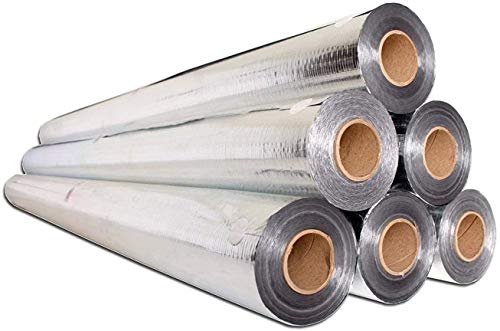
This 1,000-square-foot roll (4 ft wide, 250 ft long) provides a high-reflectivity barrier that minimizes radiant heat transfer. Its aluminum foil composition aims to reduce cooling costs by responding well to hot summers, with a claimed reflective value exceeding 99.7%. The product emphasizes tear resistance and ease of cutting, while maintaining a non-toxic, moisture-tolerant profile suitable for various building types.
SmartSHIELD -1.5mm Reflective Insulation Roll

INSULATION MARKETPLACE presents a 400-square-foot, 48-inch-wide reflective insulation roll with a foam core and dual-sided foil. This combination aims to offer a robust radiant barrier while maintaining structural flexibility. The product highlights include significant radiant energy reflectivity and the inclusion of a vapor barrier, helping to curb condensation and improve indoor comfort in varied climates.
Insultex IHW-100 House Wrap

Insultex IHW-100 emphasizes breathability and drainage with high tear resistance and strong dimensional stability. The wrap is designed to perform well under moisture exposure, reducing the risk of moisture-related issues in wall assemblies. Its balance of tear resistance and air-permeability aims to support a durable, energy-conscious envelope.
Houseables Radiant Barrier Roll

Houseables offers a 1,000-square-foot radiant barrier with perforated aluminum foil designed to reflect heat and reduce summer cooling loads. The product emphasizes high reflectivity (listed near 97%), ease of handling and cutting, and a moisture- and humidity-resistant profile suitable for various installations in attics or wall assemblies.
Buying Guide: Key Purchase Considerations
- R-value and radiant reflectivity: Choose products with strong radiant barrier properties for hot climates, or breathable wraps where moisture management is a priority.
- Air and vapor protection: Consider whether you need a true air barrier, a vapor barrier, or a combination to prevent condensation and improve energy efficiency.
- Durability and tear resistance: For long-lasting installations, select materials described as tear-resistant or high tear strength, especially in retrofit projects.
- Installation practicality: Look for rolls with easy cutting, flexible handling, and compatibility with standard building practices.
- Moisture handling: If humidity exposure is a concern, prioritize materials with proven drainage, breathability, and mold-resistance properties.
- Code compliance and materials safety: Verify that the wrap meets local building codes and is non-toxic for indoor use.
- Climate alignment: In extremely hot or cold regions, weigh the benefits of reflective foils against breathable wraps to balance energy savings and indoor comfort.
- Cost vs. performance: Compare upfront material costs with long-term energy savings, accounting for installation time and required tools.
- Compatibility with other insulation: Ensure the wrap works with existing insulation types and does not impede moisture drainage or structural integrity.
Across options, reflective foil barriers excel at reducing radiant heat, while breathable wraps support moisture management and durability in wall assemblies. For retrofit projects, ease of installation and compatibility with existing framing can be decisive, whereas new construction may benefit from a combined approach that blends air sealing, moisture control, and thermal performance.