Gaps and cracks around homes provide inviting entry points for mice. Expanding foam sealants offer a pesticide-free barrier that fills irregular gaps, insulates, and helps prevent intrusions. This guide highlights top expanding foam products designed to block rodents while keeping your living spaces airtight and comfortable. Each option shown below is suitable for interior or exterior use, depending on the product, and integrates with common building materials.
| Product | Brand | Key Benefit | Typical Use |
|---|---|---|---|
| Tomcat Rodent Block Expanding Foam Barrier | Tomcat | Water-resistant, long-lasting rodent barrier | Filling gaps to prevent mice entry |
| DAP Mouse Shield Foam Sealant | DAP | EPA-registered sealant that resists pest attack | Interior and exterior gaps and cracks |
| Loctite Tite Foam Gaps & Cracks | Loctite | High-density, UV-resistant expanding foam | Gaps up to 1 inch |
| Akfix 895 PestBlocker | Akfix | Strong barrier for holes and gaps | Gaps, cracks around walls and utilities |
| [Upgraded] Rodent Barrier Kit | PAMAZY | Combination of steel wool and spray foam for large openings | Medium to large hole entry points |
Tomcat Rodent Block Expanding Foam Barrier
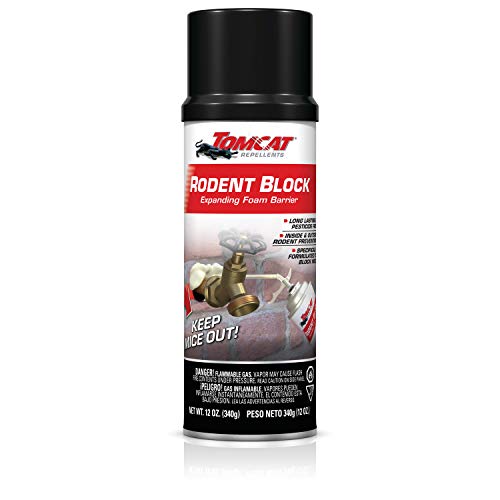
Tomcat’s Rodent Block Expanding Foam Barrier is designed to fill gaps and cracks to block mice from entering a home. The spray foam is marketed as a pesticide-free option that creates a long-lasting, airtight, and water-resistant bond with common building materials. The product is suitable for use around door thresholds, foundation joints, and other penetration points where rodents typically gain access. When applied properly, the foam expands to create a dense barrier that deters rodent activity while helping to seal out drafts and moisture.
Key features include: a pesticide-free formulation, expansion that adheres to many substrates, and durable weather resistance. For best results, apply in layers to avoid over-expansion, particularly in confined spaces. This option is often used as part of a broader rodent prevention plan, combining physical barriers with sanitation and exclusion strategies.
DAP Mouse Shield Foam Sealant and Blocker

DAP Mouse Shield Foam Sealant is an expanding polyurethane foam sealant intended for interior and exterior gaps. It acts as a pest blocker and insulator and is EPA-registered, which adds a level of regulatory reassurance for some homeowners. The foam is designed to resist pest intrusion over time and help seal gaps in garages, basements, and around utility penetrations. It also claims effectiveness against other pests that might target small entry points around structures.
Important considerations include: interior and exterior versatility, pest-resistance features, and the product’s removable handling where necessary. As with any sealant, surface prep (clean, dry surfaces) improves adhesion and inhibits future gaps caused by building movement. Use in well-ventilated areas and follow label directions for application and cure times.
Loctite Tite Foam Gaps & Cracks

Loctite Tite Foam Gaps & Cracks is an expanding polyurethane sealant designed to fill gaps and cracks up to 1 inch. The foam provides high density and a uniform cell structure, aiming to deliver durable insulation and a robust barrier against pests. The product emphasizes UV resistance for outdoor durability, helping protect the seal in sun-exposed areas near foundations or exterior walls. It’s frequently used around windows, doors, pipes, and other penetrations where rodents might attempt entry.
Key considerations include its ease of use, expansion control, and suitability for small-to-moderate gaps. The foam’s density contributes to a tighter seal that reduces air leaks, which can help with energy efficiency along with rodent exclusion. Proper curing and trimming are recommended to ensure a clean, effective finish.
Akfix 895 PestBlocker Insulation Spray Foam

Akfix 895 PestBlocker is a two-pack of insulation spray foam designed to seal gaps and cracks while forming a barrier against pests. The product emphasizes resilient and reliable protection for homes, aiming to prevent entry points and block holes around walls, floors, and utility penetrations. Its comprehensive sealing capabilities are described as suitable for long-lasting protection, contributing to a more energy-efficient and draft-free space.
Considerations include its expansion properties, adhesion to various surfaces, and the potential need for multiple coats for larger gaps. When used as part of a broader exclusion strategy, this foam can help reduce pest pressure by limiting access routes while maintaining a weather-resistant seal.
[Upgraded] Rodent Barrier Kit

The Rodent Barrier Kit combines premium steel wool with a spray polyurethane foam to form a dual-action barrier against mice and other rodents. The kit includes materials to reinforce openings such as pipes, vents, and holes in walls or foundations. The steel wool provides a physical chew-resistant layer, while the foam fills gaps and expands to seal irregularities. This combination is aimed at medium to large openings where rodents may attempt entry, offering a long-lasting solution that deters gnawing and intrusion.
Key considerations include the compatibility of steel wool with foam, the ease of fitting around complex openings, and the overall cost-effectiveness of using a multi-material barrier. This approach suits homeowners dealing with multiple entry points or larger gaps that require robust sealing and chewed-proof protection.
Buying Guide: Key Considerations For Choosing Rodent-Blocking Expanding Foams
- Gap size and location: For gaps up to 1 inch, consider Loctite Tite Foam Gaps & Cracks. For larger openings, look at big-gap variants or kits that combine steel wool with foam.
- Adhesion and substrate compatibility: Check whether the foam adheres well to wood, masonry, metal, and painted surfaces. Exterior-use formulas should resist UV exposure and moisture.
- Pest resistance and safety: EPA-registered products and pesticide-free options may be preferred in homes with children and pets. Confirm whether the foam’s composition deters chewing by rodents.
- Expansion control: Foams that over-expand can warp frames or crack plaster; layered applications help manage volume and achieve a better seal.
- Durability and insulation: High-density foams provide stronger barriers and better insulation against air leaks, moisture, and temperature fluctuations.
- Ease of use and clean-up: Look for clog-resistant nozzles, paintability, and trim-ability for a neat finish after curing.
- Combination approaches: Kits that pair steel wool with foam address both chewing resistance and gap sealing, offering enhanced rodent deterrence for larger openings.
- Regulatory and safety notes: Follow label directions for ventilation, curing times, and disposal. Some products require curing in well-ventilated areas.
- Maintenance plan: Foams may degrade over time in harsh outdoor environments; plan periodic inspections and re-sealing as part of a broader exclusion strategy.
In choosing the best expanding foam for mice, consider the size of the gaps, the exposure (indoor vs outdoor), and whether a multi-material barrier is needed for larger openings. A comprehensive approach that combines sealing with proper sanitation and entry-point exclusion tends to yield the most reliable rodent control results.