For many homes, navigating stairs with limited mobility requires reliable chair elevators or stair chairs. This guide highlights five practical options, detailing design, load capacity, portability, and ease of use to help you compare features and choose the right solution for safe, confident stair travel.
| Product | Brand | Key Feature | Load Capacity | Image |
|---|---|---|---|---|
| LINE2design EMS Stair Chair 70015-Y | LINE2design | 2-Wheel Deluxe Evacuation, high visibility yellow | 400 lb |  |
| Manual Lift Stair Chair (350 lbs) | DnyioVpl | Folds compactly, 2 wheels for movement | 350 lb |  |
| Manual Lift Stair Chair (350 lbs) | GOSHET | Wider seat for comfort, robust aluminum frame | 350 lb | 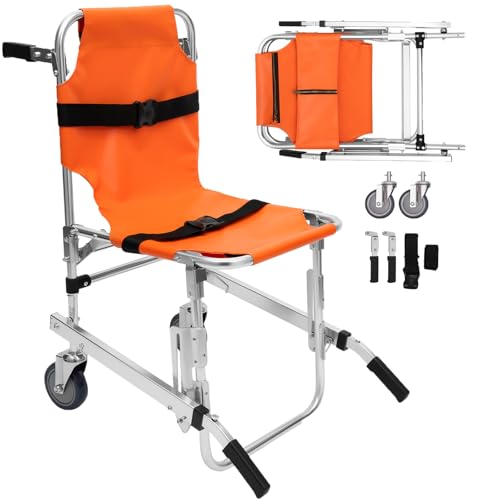 |
| Fotree One Step Stool (440 lbs) | fotree | Non-slip, compact step platform for quick supports | 440 lb |  |
| Fotree One Step Stool (440 lbs) | fotree | Non-slip top and bottom, indoor/outdoor versatility | 440 lb |  |
Note: This article uses product details from publicly listed specifications. Specifications can change; confirm current product details on the retailer page before purchasing.
LINE2design EMS Stair Chair 70015-Y
LINE2design’s EMS Stair Chair 70015-Y is designed for emergency patient transfer and routine stair travel. It features a bright yellow frame for high visibility, molded hand grips, and foldable construction for compact storage. The chair includes rear wheel brakes on both wheels to lock in place during transfers, and a black vinyl seat and backrest that withstands frequent cleaning. The chair supports up to 400 lb, making it suitable for various patient transfer scenarios. Its two-wheel design facilitates smooth movement across stair landings, while head-end and foot-end lift handles provide secure control for caregivers.
Manual Lift Stair Chair, 350lbs (DnyioVpl)
This manual lift stair chair from DnyioVpl emphasizes portability and durability. Built with high-quality aluminum alloy and PVC, the chair is rust-resistant and weather-ready for various environments. A foldable design reduces its footprint to fit in a car trunk or storage space, with a compact size of roughly 47.24 by 21.26 by 11.8 inches when folded. It is capable of supporting up to 350.53 lb, providing a reliable option for daily transfers and emergency evacuation. The combination of sturdy construction and a lighter frame aims to balance safety with convenience for caregivers and patients alike.
Manual Lift Stair Chair (GOSHET) 350lbs
GOSHET’s Manual Lift Stair Chair is designed for daily transfers and elder care. The chair uses a high-strength aluminum alloy frame with chrome-plated accents and a durable PVC cushion. The seat is 17.32 by 18.5 inches, offering a comfortable fit for a range of users, with a maximum load of 350.5 lb. Reinforced seams and a robust construction ensure long-term usability, while the foldable mechanism provides convenient storage and transport. This model emphasizes reliability for regular household use or care facility environments.
Fotree One Step Stool, 3.5 Inch High Rise (440 Lbs)
Fotree’s One Step Stool is a practical aid for stairs, cars, beds, and showers. Made from polypropylene, it balances strength with lightweight portability. Its dimensions are 17 inches by 13 inches by 3.5 inches, with a maximum load capacity of 440 lb. The stool features a non-slip top surface and a non-slip grip on the bottom, aided by drainage holes to prevent water buildup. The compact design (about 2.6 lb) makes it easy to move between rooms while still providing solid footing on slippery surfaces. This product is suited for quick, temporary steps and as a support aid for stair access in homes with limited mobility.
Fotree Second Step Stool, 3.5 Inch High Rise
Fotree’s second listed step stool mirrors the first in design and purpose, offering the same polypropylene construction, 440 lb capacity, and anti-slip features. Its ergonomic footprint supports easy placement beside stairs, beds, or chairs, making it a versatile aid for daily tasks that involve elevation. The step stool’s compact size and light weight enable effortless relocation and storage, while the non-slip surface improves stability on stairs and slick surfaces in kitchens or bathrooms.
Buying Guide
Key purchase considerations when choosing a chair elevator or stair assist include load capacity, mobility, and safety features. Here are multiple perspectives to balance needs:
- Load capacity and user size: If you or a caregiver will regularly transfer heavier individuals, prioritize chairs with higher weight limits (e.g., 350–400 lb ranges) and sturdy seat dimensions for comfort and safety.
- Mobility and storage: Folding models offer better storage in small spaces or vehicles. Consider whether a two-wheel design or a four-wheel setup better suits your home’s stairs or landing area.
- Safety features: Look for locking brakes on wheels, secure head and foot-end handles, and durable upholstery that can be cleaned easily in clinical or home settings. Non-slip surfaces on step stools add stability on wet surfaces.
- Material and durability: Aluminum frames provide lightness and corrosion resistance, while vinyl seating resists wear and cleaning agents. Reinforced seams and robust construction reduce wear over time.
- Versatility: Some products function as portable stair chairs, while others are primarily step stools. Consider whether you need a dedicated chair for patient transfer or a general elevation aid for daily tasks.
- Portability vs. stability: Lighter chairs improve transport between rooms but may sacrifice some rigidity. Heavier models tend to feel more stable on stairs but require more space to handle.
In sum, the best option depends on user weight, staircase configuration, and planned usage. For emergency or frequent transfers, prioritize high load capacity, secure harnessing options, and reliable wheel brakes. For occasional stair access or simple elevation tasks, foldable chairs or sturdy step stools provide cost-effective, space-saving solutions.